
FIA presents
Talented Artful People
Tap into creativity and learn about our featured artists.
Meet fine artist Oleg Matveyev. He is our first international member. He was born in the USSR and now lives in Scotland. His story is an attestation of determination and resilience.
[FIA] Did you always know you wanted to be an artist?
[OM] Art is my hobby and not a profession. In day life, I was a computer engineer, PhD in computer engineering and head of laboratory, presales consultant, deployment manager and now a sales manager. Art has been a place for rest, rewinding and finding a life balance. But I liked it when my paintings were sold.
[FIA] When did you begin painting, and where did you receive your art education?
[OM] I was born left-handed, but at that time in the USSR, there was a perception that all need to be right-handed. Thus, my parents tried to reteach me to use my right hand. My passion for drawing started when I was a 12yo boy. We moved to Moscow from Sverdlovsk. Drawing with the left hand was the only thing I was allowed to do. I switched from pen and ink to brush and paint when I was moved to Scotland by NCR.
[FIA] Who are a few artists you admire and why?
[OM] Ivan Aivazovsky. I admire his vision of water and sea. Also, I know I will never be able to paint water as he did. Albrecht Dürer. As I started as a graphics artist, I liked Albrecht’s style, technique and themes. Gustave Dore. The same about graphics technique and his fantastic illustrations. Besides the mentioned artists I love works of J.M.W. Turner, John Constable, and many others. Finally Georges Seurat, because he started the pointillistic painting technique, and I use it now.
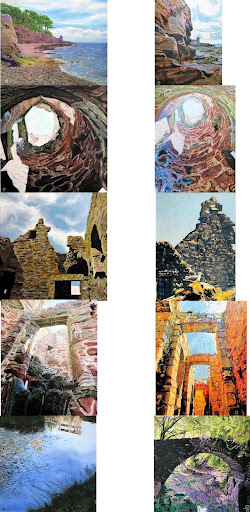
Left Column titled “Strokes” Shows images rendered with brush techniques. Right Column titled “Dots” Shows the same scenes rendered with a dotted or pointillist technique.
Scenes depicted from top to bottom : 1. Coastal landscape with rocky cliffs and water.
2. Circular tunnel or cave view looking outward toward light.
3. Ancient ruins with a person for scale.
4. An architectural corridor with arched openings.
5. A reflective water scene in a cave.
Seeing Scotland Anew: My Journey from Strokes to Dots
Art has been a constant companion in my life since I first picked up a pencil at the age of twelve. What began as a childhood hobby in Moscow quickly became a lifelong passion—a way to process the world, capture fleeting moments, and express what words could not.
In 2000, a well-known American company offered me the chance to relocate from Moscow to Scotland. This move was more than a change of scenery; it was the beginning of a new chapter in my artistic journey. Suddenly, I found myself immersed in the landscapes, ruins, and ever-changing light of Scotland—a place both ancient and alive, familiar yet foreign. My work naturally gravitated toward the theme of “Scotland through the eyes of a foreigner,” exploring the country’s beauty and history from my unique perspective.
But in 2018, my world shifted again. A sudden retinal detachment in my left eye led to five operations over the next few years. Despite every effort, by 2021 I had lost the ability to see with that eye. The impact on my art was immediate and profound. I struggled with 3D orientation and found it nearly impossible to paint thin lines—an essential part of my previous technique.
At first, I feared this might be the end of my painting. But art, like life, is about adaptation. After a period of experimentation and frustration, I discovered a new way to express myself: through dots. Pointillism, a technique I had admired but never fully explored, became my new language. Each dot was a small act of defiance—a way to reclaim control, to build images layer by layer, and to embrace the tactile, meditative process of creation.
In 2023, I launched a new series: “Scotland in Pointillistic Style.” This body of work invites viewers to experience the interplay of light, history, and nature that defines the Scottish landscape, rendered in vibrant, textured detail. The process is slow and deliberate, but it allows me to capture the essence of a place in a way that feels both intimate and expansive.
Looking back, I see a clear evolution in my collections. My earlier works—what I now call the “Strokes” series—were defined by sweeping lines and bold gestures. They reflect a time when my vision was whole and my approach was more direct. The “Dots” series, by contrast, is about patience, adaptation, and finding beauty in limitation. Each collection tells a different part of my story, but both are united by a love of Scotland and a commitment to seeing the world with fresh eyes.
If there is one lesson I hope readers take from my journey, it is this: disability of any kind is not a reason to abandon your passions. Challenges may force us to change our methods, but they can also open new doors to creativity and self-expression. Art is not about perfection—it is about persistence, curiosity, and the courage to keep going, no matter what.
Thank you, Oleg for sharing your story and your paintings with us.
Fig.2. Oleg Matveyev and his painting “The Old Stones of Edzell Castle” at “The Thread That Pulls” exhibition (National Galleries, Edinburgh, 2025).
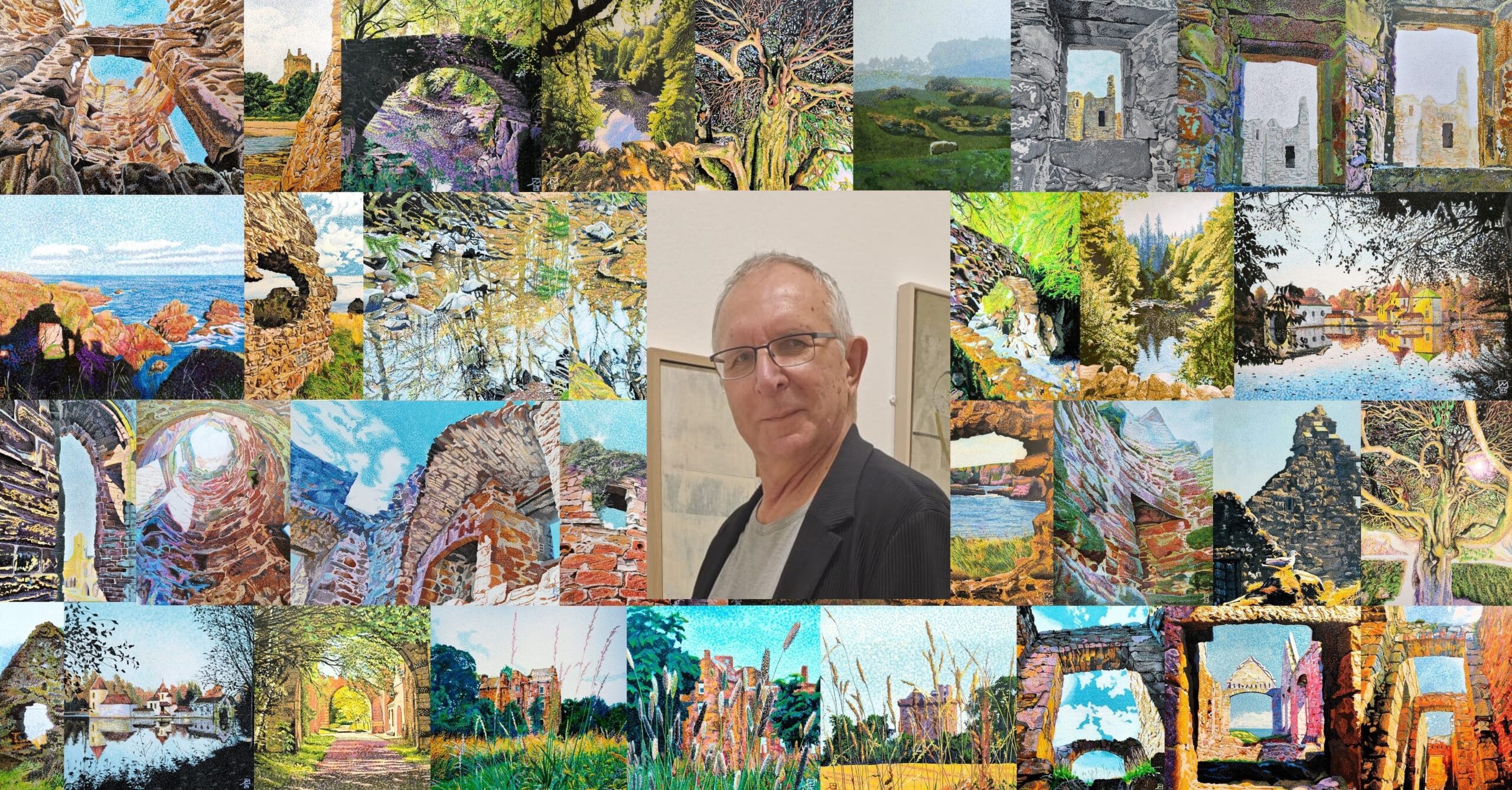
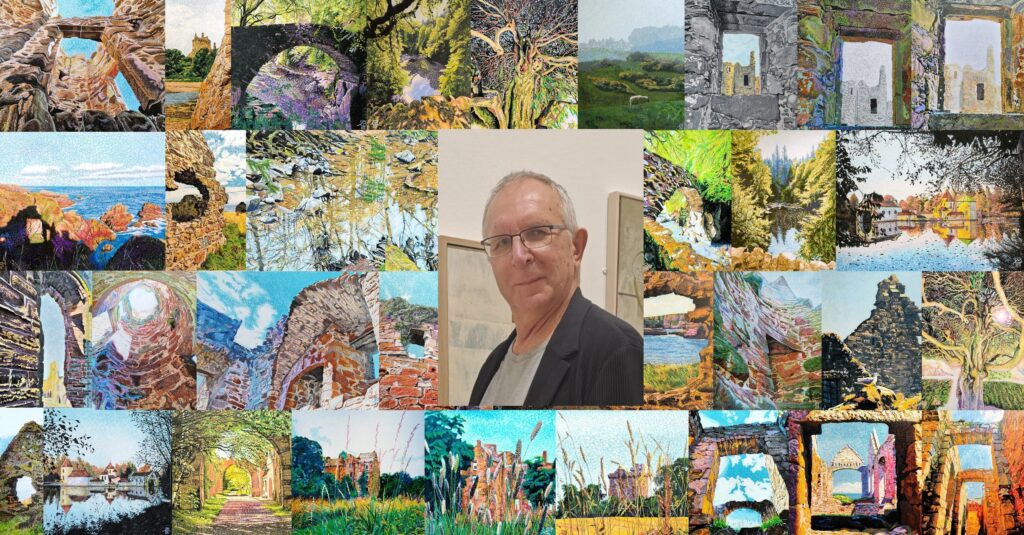
The first collage is a good illustration of my story. The second photo is proof that even an artist with disability can achieve new heights.
If you need any more information or clarification, please don’t hesitate to let me know.
Best regards,
Oleg Matveyev
You can contact Oleg via email:—————-
omsc2000@yandex.com
Discover more from Friends in Art
Subscribe to get the latest posts sent to your email.